
3 min read
The hybrid workplace technology your business needs
The modern workplace has evolved significantly, embracing a hybrid model that combines on-site collaboration with remote flexibility. This new way of...
4 min read

The hybrid workplace has become the standard model for modern businesses, combining office and remote working environments. According to Robert Half's 2025 research, 24% of new job postings now offer hybrid arrangements, reflecting the permanent shift in how we work. Success in this environment requires strategic investment in cloud-based business solutions, comprehensive document management systems and process automation that keep distributed teams connected and productive.
However, as organisations optimise their hybrid work models, business leaders must focus on the right digital workplace solutions that will enable staff and drive growth. Research from Owl Labs' 2025 State of Hybrid Work report shows that 90% of hybrid employees report being just as or more productive compared to traditional office settings—but only when equipped with the proper tools and infrastructure.
But before we outline the five essential digital workplace solutions for modern hybrid teams, there are three critical considerations when planning and implementing your digital workplace strategy.
While organisations increasingly recognise their role in environmental stewardship, the benefits of a sustainable approach extend beyond the planet. Businesses with a strong sustainability focus attract and retain better staff due to value alignment. Other benefits include improved business reputation, resource recovery, cost savings and enhanced staff morale. Digital transformation offers numerous opportunities to reduce environmental impact, from paperless workflows to reduced commuting, so build sustainability into your strategy from the outset.
One significant challenge of hybrid work is maintaining a cohesive company culture when team members aren't physically together. According to Zoom's research, hybrid workers have the highest engagement rates at 35%, followed by fully remote at 33% and in-office at 27%—demonstrating that with the right approach, hybrid models can actually enhance engagement. When creating your hybrid workplace, careful consideration must be given to maintaining a positive, collaborative culture. This results not only in happier employees but also drives productivity and growth.
Your people are your greatest resource, so keep them front and centre as your workplace evolves. Employee well-being must be prioritised alongside productivity and business outcomes. Research shows that workers have different needs and responses to their work environments. FlexOS data indicates that 38% of US firms have adopted structured hybrid models, with an average of 2.49 days in-office per week, demonstrating the variety of approaches that organisations are implementing. Consulting with staff throughout the adoption process ensures your hybrid workplace plan succeeds.
With these principles in mind, here are five essential digital workplace solutions to include in your hybrid workforce strategy.
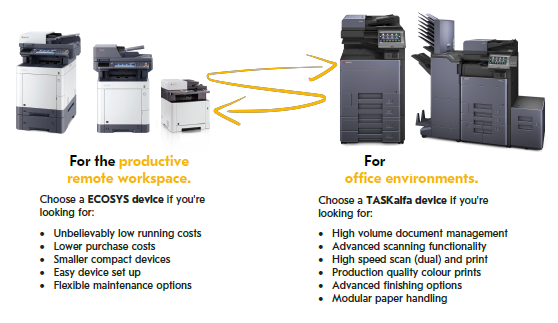
Printers represent a critical security consideration in hybrid environments. With employees working from multiple locations, organisations need robust printing infrastructure that maintains security whilst providing flexibility. Providing enterprise-grade business printers for home offices delivers better security and proves more cost-effective long-term, thanks to significantly lower running costs. Modern multifunction devices like the Kyocera ECOSYS range are designed specifically for hybrid environments, featuring cloud connectivity, advanced security protocols and flexible maintenance options suited to distributed workforces.
Additionally, cloud print management software enables IT teams to deploy, monitor and maintain printing infrastructure remotely whilst providing users with seamless access to print resources from any location.
Business automation allows staff to focus on higher-value tasks whilst routine administrative and processing work is handled automatically, reducing time and costs substantially. Intelligent automation platforms enable organisations to gather and analyse data, communicate between systems and perform repetitive tasks with minimal human intervention. According to OfficeRnD's 2025 analysis, 90% of CEOs report reduced business costs after adopting hybrid work models, with automation playing a critical role in these efficiencies.
Process automation services such as robotic process automation (RPA) and intelligent document processing transform workflows across finance, operations and customer service. For example, automated invoice processing can reduce processing times from days to hours whilst maintaining full compliance and audit capability.
With employees working from multiple locations, robust systems for managing information flow between distributed teams become essential. An enterprise content management (ECM) system allows organisations to manage all data and documents in a centralised repository whilst automating tasks such as classification, approval routing and version control. For hybrid workplaces, ECMs enable productivity improvements and facilitate collaboration across teams regardless of location.
Kyocera Digital Workplace Solutions integrates comprehensive document management with collaboration capabilities, creating a unified platform where teams can access, share and work on documents seamlessly. These systems provide version control, automated retention policies, secure access controls and intelligent search functionality—ensuring teams can collaborate effectively whilst maintaining compliance and governance requirements.
According to research compiled by FlexOS, structured hybrid models have become the most popular approach to work flexibility for Fortune 500 companies, making integrated document management systems more critical than ever for coordinating work across locations.
Strong communication forms the foundation of organisational success, and hybrid workplaces demand sophisticated tools to support this. Project management and collaboration platforms enable managers and teams to coordinate work, track progress and address issues promptly. Owl Labs' 2025 data reveals that 69% of managers report that hybrid work has actually improved their teams' performance, largely due to better communication tools and practices.
Without effective communication between managers, employees and stakeholders, projects face significantly higher failure rates. Essential collaboration tools include task management applications, document-sharing platforms, e-signature services, and video conferencing solutions. Research indicates that 49% of employers now provide training on conducting effective hybrid meetings, recognising the strategic importance of these communication capabilities.
Modern collaboration platforms integrate with document management and automation systems, creating a seamless digital workplace experience. This integration eliminates the friction of switching between disconnected tools, improving productivity and user satisfaction.
Forward-thinking organisations are leveraging artificial intelligence and advanced analytics to optimise their hybrid work environments. Data from Owl Labs' 2025 report shows that 80% of employees now use AI in the workplace, up from 72% in 2024, with 27% using it daily. Companies are providing dedicated AI training, with 64% actively supporting AI adoption.
AI applications in hybrid workplaces include intelligent document capture that automatically classifies and extracts data, predictive analytics for workforce planning, natural language processing for advanced search capabilities, and virtual assistants that streamline routine tasks. Advanced analytics help organisations understand space utilisation, optimise meeting room allocation and identify productivity patterns across hybrid teams.
Kyocera's intelligent automation platforms incorporate AI capabilities that continuously learn and improve, delivering increasing value over time whilst reducing manual intervention requirements.
Building a resilient and productive hybrid work environment requires the right combination of hardware, software and processes. According to Archie's 2025 analysis, 69% of employers report improved employee retention after introducing hybrid policies, with the greatest improvements seen in organisations that invested in comprehensive digital workplace solutions.
Professional managed IT services provide the foundation for successful hybrid work implementation, ensuring communication tools remain secure, updated and properly integrated whilst network security solutions protect sensitive business communications across distributed teams.
Explore how Kyocera's cloud-powered digital workplace solutions can help your organisation implement an effective hybrid strategy that equips your employees to work anywhere, any time, whilst maintaining security, productivity and collaboration.

Kyocera Document Solutions provides innovative products, software and ICT services for hybrid work environments, enabling businesses to implement smart workplace solutions that drive business transformation and resilience.

3 min read
The modern workplace has evolved significantly, embracing a hybrid model that combines on-site collaboration with remote flexibility. This new way of...

3 min read
Today's business environment demands organisations be prepared for disruption at any moment. According to Gallup's 2025 research, hybrid work has...

4 min read
The digitisation processes of physical documents has become increasingly important as organisations have adopted hybrid working models. In fact, 85...